Our paper “Euclid Quick Data Release (Q1): XXXVIII. Euclid spectroscopy of quasars. 1. Identification and redshift determination of 3500 bright quasars” has been published by Astronomy & Astrophysics.
- ADS: 2026A&A…711A.285E
- DOI: 10.1051/0004-6361/202558490
- arXiv: 2512.08803
- CDS: J/A+A/711/A285
- PDF: Download PDF
This post is the first entry in a new series, AGN Sciences with Euclid, where I’ll keep notes, figures, and data products related to my Euclid-based AGN and quasar work.
Overview
In this paper we present a visually inspected sample of nearly 3500 bright quasars identified with Euclid/NISP red-grism spectroscopy in the Q1 fields. One of the main takeaways is that Euclid slitless spectroscopy already delivers reliable quasar redshifts over a broad redshift range, including not only Gaia-detected quasars but also a redder non-Gaia population that is harder to recover with optical selection alone.
The paper includes:
- a catalogue of Euclid Q1 bright quasars with spectroscopic redshifts;
- visual-inspection classifications and redshift-quality information;
- an analysis of Gaia and non-Gaia quasar subsets;
- a rest-frame near-UV to near-IR Euclid quasar composite spectrum;
- examples and diagnostics for NISP-based quasar redshift determination.
Euclid Q1 quasar spectroscopy in a nutshell
What Euclid/NISP quasar spectra look like
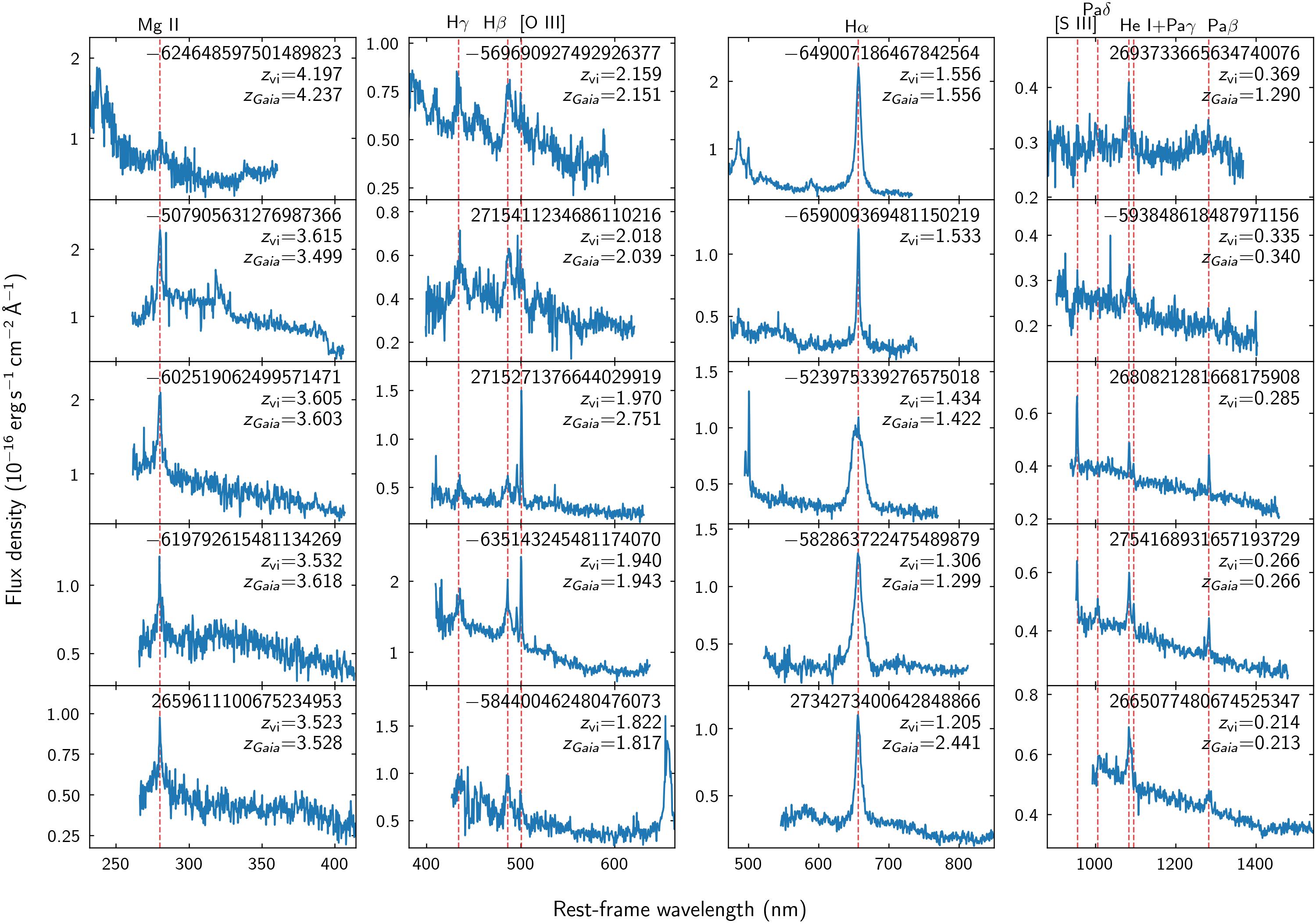
Figure 1 shows a few representative Euclid/NISP spectra from the visual-inspection sample. In practice, the redshift constraints come from broad and narrow emission features such as Mg II, Hβ, [O III], Hα, and near-infrared hydrogen lines when they fall inside the NISP wavelength range.
Gaia and non-Gaia quasars in Euclid colour space
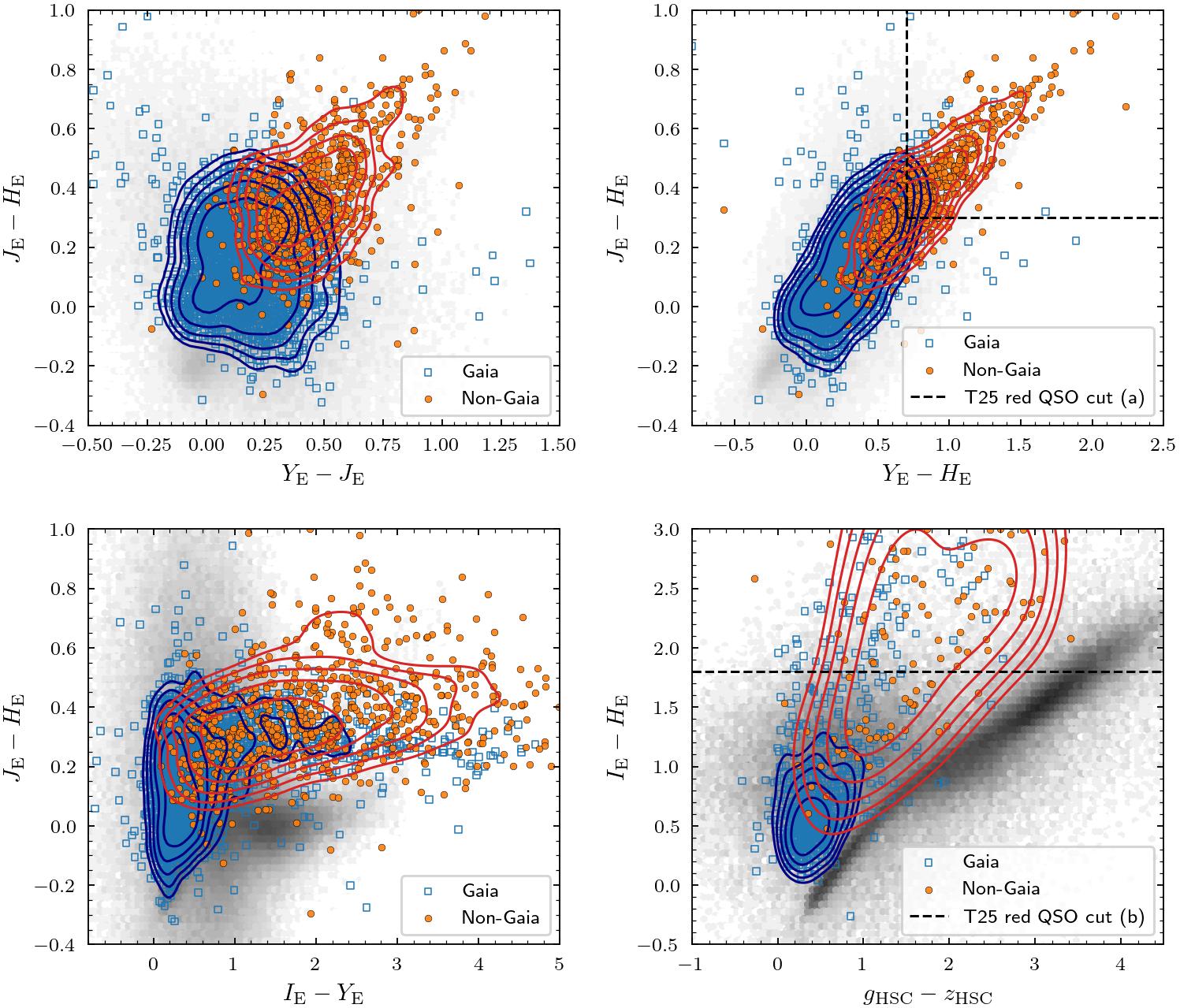
An important part of the Q1 sample is the comparison between Gaia-detected and non-Gaia quasars. The non-Gaia subset is generally redder and optically fainter, which makes it a nice demonstration of how Euclid can extend quasar selection beyond Gaia-based and purely optical samples.
Redshift determination with slitless spectroscopy
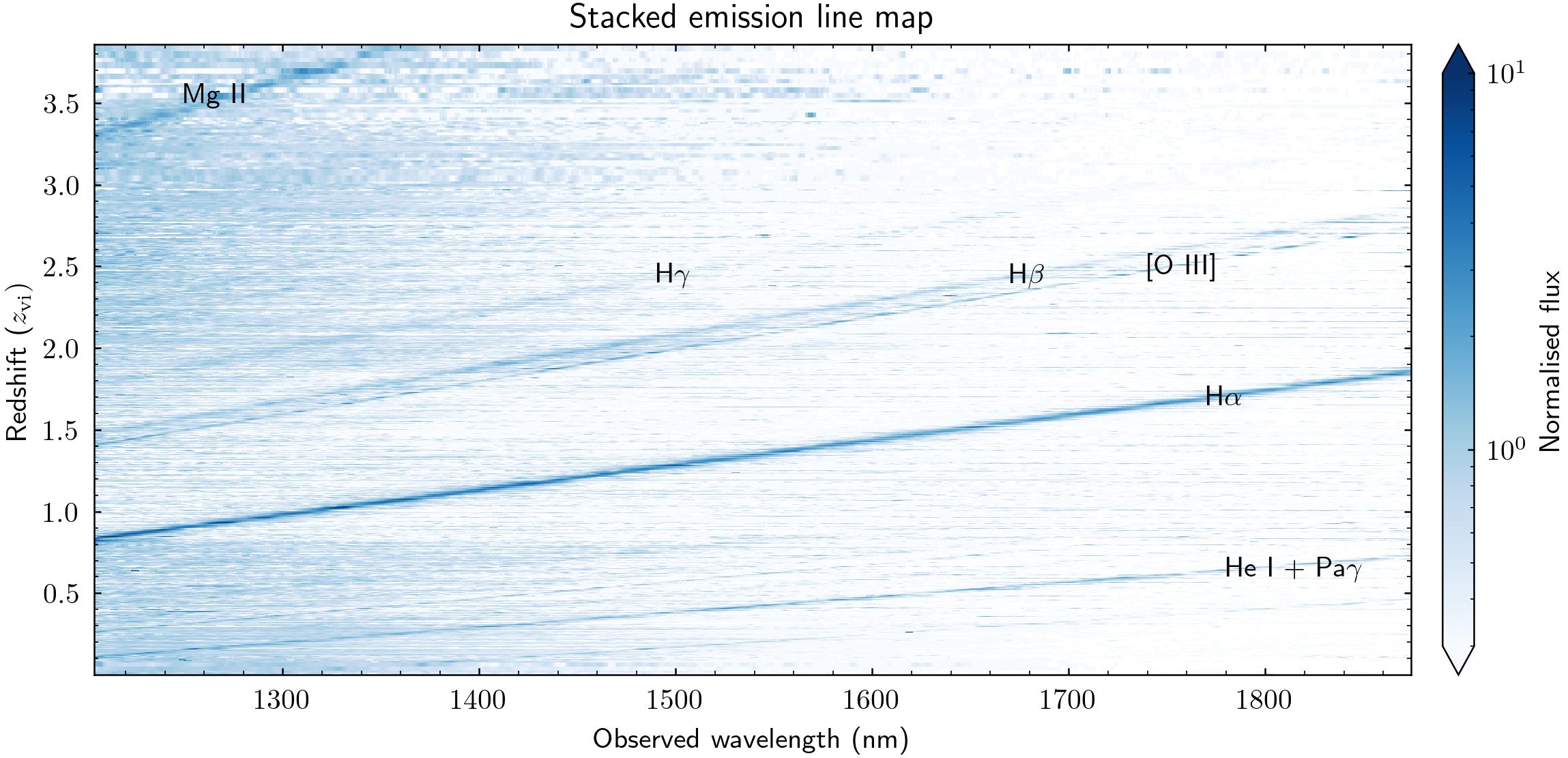
Figure 3 is a convenient way to see how the main quasar emission line features shift with redshift. In the observed wavelength versus redshift plane, the strongest emission lines trace diagonal tracks. This makes it easy to see which lines drive the redshift determination in different intervals, and where single-line ambiguities can become a problem.
A telluric-free Euclid quasar composite spectrum
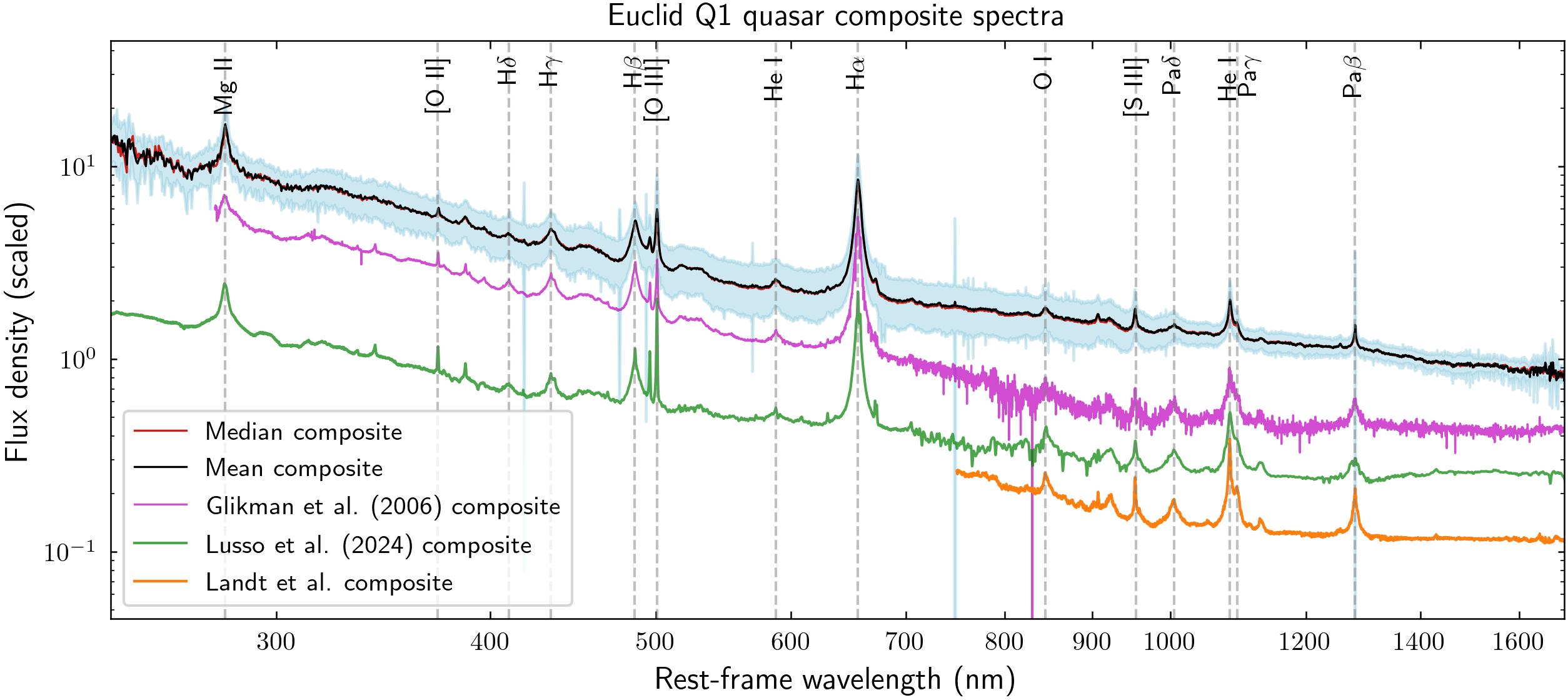
The Q1 sample also makes it possible to construct a Euclid quasar composite spectrum covering rest-frame near-UV to near-IR wavelengths. Because Euclid observes from space, the composite is free of telluric absorption, which makes it a useful reference for future near-infrared quasar and AGN work.
Individual examples
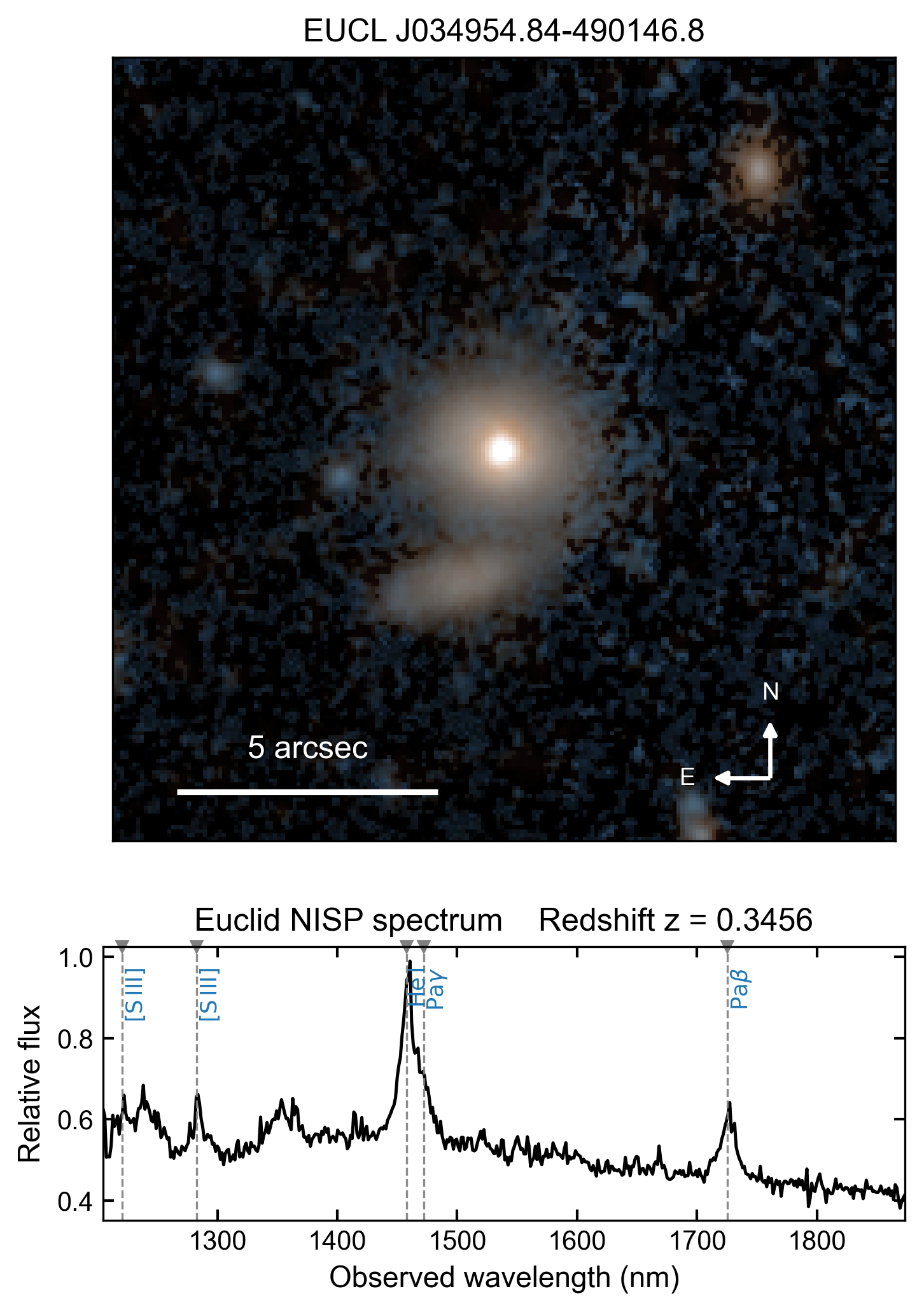
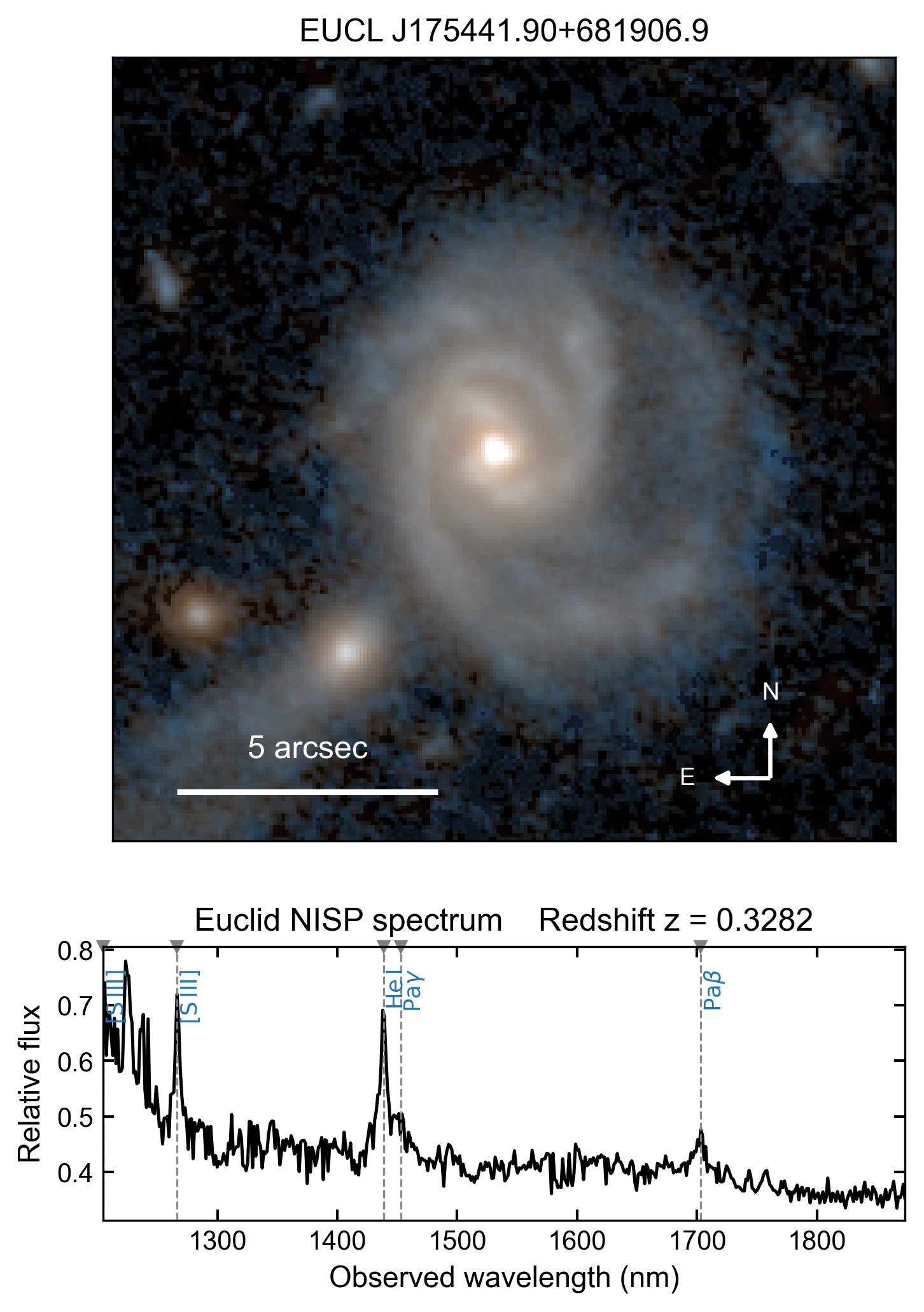
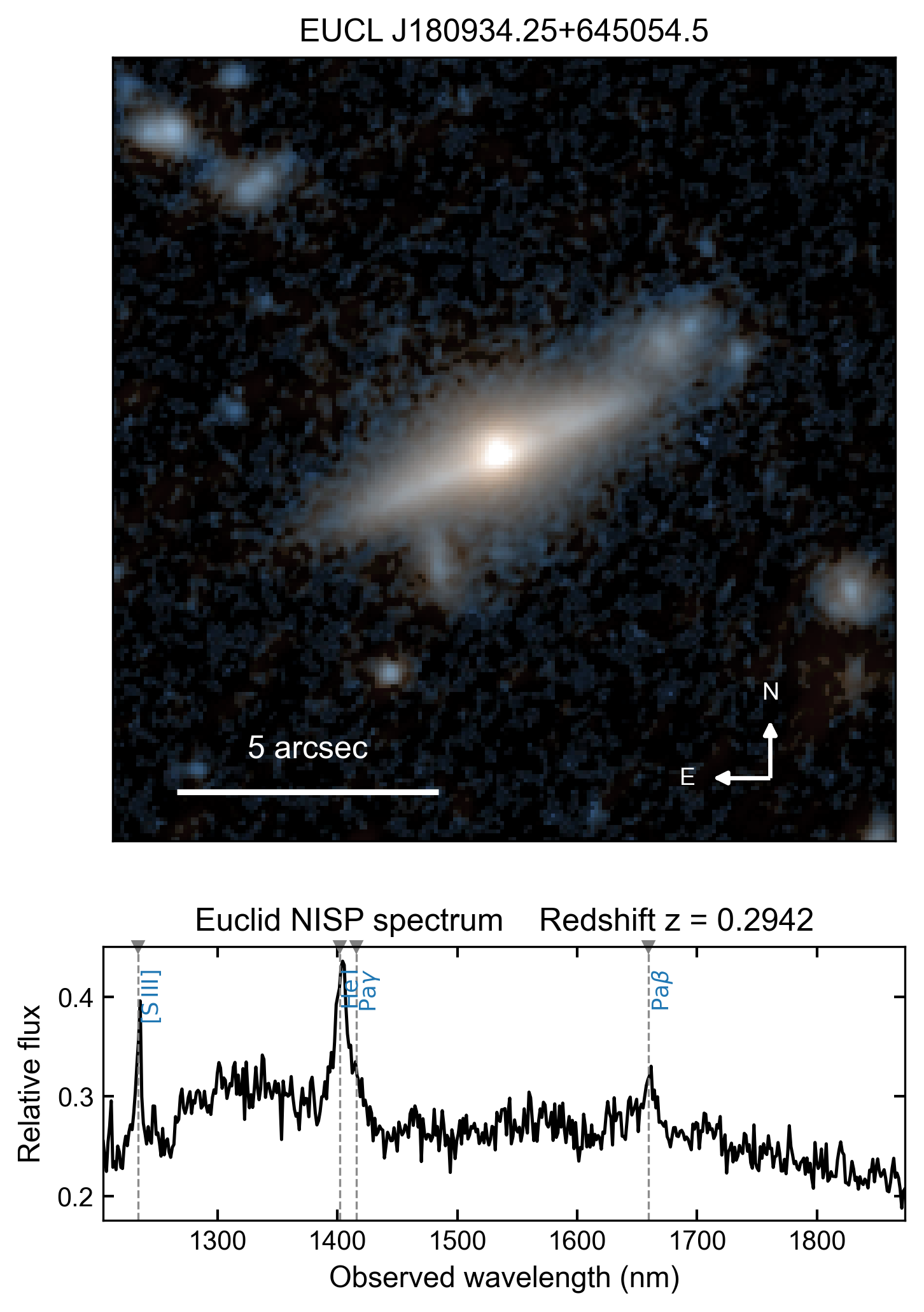
Besides the population-level figures, it is worth showing a few individual low-redshift quasars simply because the Euclid images are beautiful. They also give a more concrete sense of the sample and highlight Euclid’s excellent spatial resolution and image quality, reaching about 0.16 arcsec in visible light. In Figure 5, the upper panels show the Euclid images and the lower panels show the NISP spectra used for redshift measurement.
- EUCL J034954.84−490146.8 — clean NISP redshift example with strong He I and Paβ.
- EUCL J175441.90+681906.9 — resolved host with spirals and possible nearby companion.
- EUCL J180934.25+645054.5 — active nucleus in an edge-on galaxy.
Data products
The tables are now available from the official CDS catalogue record:
- Euclid Q1 quasar composite spectrum (Table 2): download
table2.dat. - Euclid Q1 bright-quasar catalogue (Table B.1): download
tableb1.dat.gz, download the FITS version hosted here, or query the catalogue with VizieR. - Table descriptions, column definitions, and notes: CDS
ReadMe.
Please cite the A&A paper below if you use these data.
And stay tuned: Euclid DR1 should bring a much larger sample of spectroscopically identified quasars. More about the release is available on the Euclid DR1 page.
Suggested citation
Euclid Collaboration: Fu, Y., Bouwens, R., Caputi, K. I., et al. 2026, A&A, 711, A285. https://doi.org/10.1051/0004-6361/202558490.
BibTeX entry:
@ARTICLE{Q1-SP068,
       author = {{Euclid Collaboration: Fu}, Y. and {Bouwens}, R. and {Caputi}, K.~I. and {Vergani}, D. and {Scialpi}, M. and {Margalef-Bentabol}, B. and {Wang}, L. and {Bolzonella}, M. and {Banerji}, M. and et al.},
       title = "{Euclid Quick Data Release (Q1): XXXVIII. Euclid spectroscopy of quasars. 1. Identification and redshift determination of 3500 bright quasars}",
      journal = {A\&A},
     keywords = {techniques: spectroscopic, catalogs, galaxies: active, galaxies: distances and redshifts, quasars: general, infrared: galaxies, Astrophysics of Galaxies, Instrumentation and Methods for Astrophysics},
         year = 2026,
        month = jul,
       volume = {711},
          eid = {A285},
        pages = {A285},
          doi = {10.1051/0004-6361/202558490},
archivePrefix = {arXiv},
       eprint = {2512.08803},
 primaryClass = {astro-ph.GA},
       adsurl = {https://ui.adsabs.harvard.edu/abs/2026A&A...711A.285E},
      adsnote = {Provided by the SAO/NASA Astrophysics Data System}
}